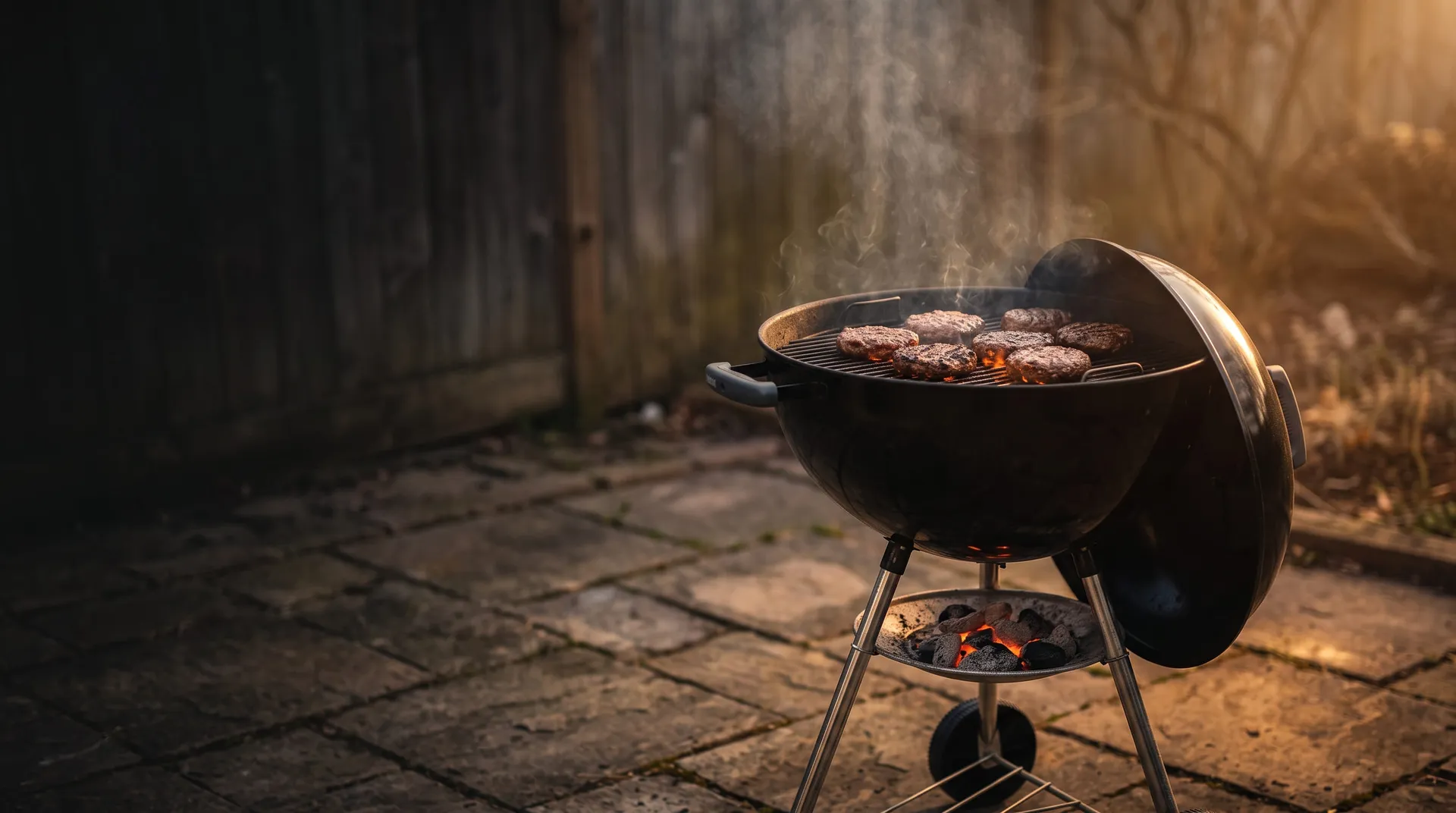
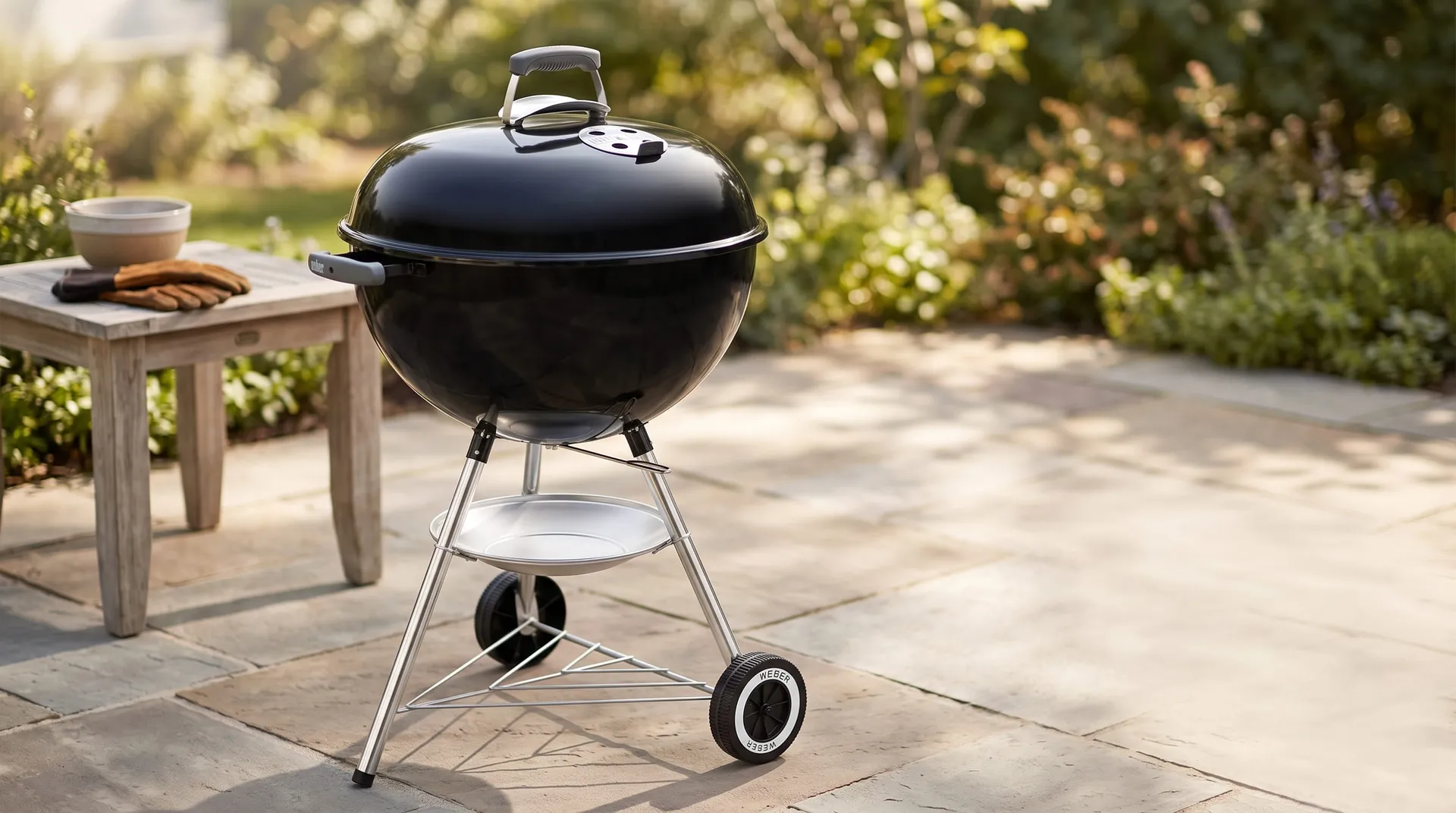
If no pick matched you exactly, these are the things that decide whether a charcoal grill suits you, in the order they matter for most buyers.
How charcoal heat works
Every charcoal grill is an airflow machine. The bottom vent is your gas pedal: open it for more heat and close it partway to cool down. The top vent pulls air through and lets smoke out, so keep it at least partly open, because a choked exhaust makes bitter, stale smoke.
Airflow sets the heat, and the amount of charcoal mostly sets how long it lasts. With the lid closed, hot air circulates, so a kettle roasts like an oven as well as searing over the coals.
 The bottom vent sets the heat; make small changes and wait several minutes between them.
How you arrange the coals decides what a grill can cook. These three layouts cover nearly everything:
| Layout | How to build it | Use it for | Grate temperature |
|---|
| Direct, full bed | Spread a full chimney across the charcoal grate | Burgers, thin steaks, skewers | Hot, often 500°F+ |
| Two-zone | All coals on one side, nothing under the other | Thick steaks, chicken, roasts | Hot side to sear, cool side to finish |
| Snake or Minion | A curved line of unlit briquettes lit at one end, or unlit coals topped with a few lit ones | Ribs, pork butt, overnight smokes | 225–275°F for hours |
Our guide to direct vs indirect grilling shows when to use each zone, and the charcoal grill temperature control guide gives vent settings for each target. If you've never lit a chimney, start with how to use a charcoal grill.
Which charcoal style fits you?
| Style | Strength | Trade-off |
|---|
| Kettle | Grills and smokes, cheap, durable | Small for big smoking cooks |
| Barrel with offset firebox | Lots of space, true offset-style smoke | Budget models leak heat and burn more fuel |
| Bullet water smoker | Steady low temperatures for hours | Poor for searing |
| Kamado (ceramic) | Holds heat on little fuel, sears very hot | Heavy, expensive, slow to cool after an overshoot |
| Gravity-fed | Set-and-forget charcoal | Weight, electronics, short warranty |
Kamados are charcoal grills too. We weigh their cost against their heat retention in kamado grill vs regular grill. If a Kamado Joe is more than you want to spend, the two budget ceramics we've tested are the VEVOR 18-inch kamado, a full-size ceramic on a wheeled cart, and the compact London Sunshine 15-inch kamado for two to four people. If you would rather have steel that can't crack, the Char-Griller AKORN kamado is insulated, lighter and has a bigger grate, though it holds temperature less steadily than ceramic.
Size it to how many you feed
For one or two people, about 150 sq in is enough. For three to six, look for 350–450 sq in, and for big smokes or parties, 450 sq in or more, ideally on two grates.
A two-zone fire leaves only about half the grate over direct heat, so a small grill fills up fast. Size up one step if you plan to cook burgers and chicken at the same time.
Steel, coatings and seals
Thin steel loses heat fast in wind and cold, so the fire burns harder to hold temperature, which means more fuel and more vent changes. Porcelain-enameled steel, like on the Weber kettles and the Smokey Mountain, resists rust and holds heat better than thin painted steel.
On any smoker, tight lids and doors matter more than steel gauge alone. High-temperature gasket tape fixes most leaks on budget offsets.
Grate materials
The cooking grate is the part you touch every cook, and the material changes how it behaves:
- Cast iron holds heat for bold sear marks but rusts if left wet. Brush it hot and wipe on a thin film of oil after cleaning.
- Plated steel is cheap and light. Once the plating flakes, rust follows, so treat it as a wear part.
- Porcelain-coated steel or cast iron resists rust and releases food well, but metal scrapers can chip it.
- Stainless steel costs more and won't rust through, though thin rods don't sear as hard as cast iron.
A hinged grate, with flaps you can lift over the coals, is worth having on any kettle you plan to smoke on. It lets you add charcoal or wood without moving the food.
 Cast iron stores heat for dark marks, then needs a light coat of oil after cleaning.
Lump or briquettes?
Lump charcoal lights fast, burns hot and leaves little ash, which suits searing and kamados. The pieces are uneven, though, and it burns faster and can spark.
Briquettes are even in size and burn steadily and predictably, which suits snake and Minion smokes. They leave more ash and take longer to light. Either works in every grill here.
Skip lighter fluid and match-light charcoal, since they often leave off-flavors. A chimney starter lights coals with just newspaper or a fire starter cube, and the coals are ready when the top layer is covered in gray ash. Store charcoal in a sealed bin, because damp briquettes light poorly and burn unevenly.
Wood for smoke
Add 2–3 fist-size wood chunks to the coals for smoke flavor. Chunks smolder longer than chips, and soaking them mostly makes steam, so use them dry. Our chart of the best wood chips for smoking matches each wood to the meats it suits.
Gear you'll actually use
- A chimney starter. The fastest, cleanest way to light charcoal.
- Long tongs and heat-resistant gloves. For moving coals and grates, not just food.
- An instant-read thermometer. Cooks are judged by internal temperature, not time.
- A wireless probe for long smokes. It shows pit and meat temperature without lifting the lid.
- A metal ash can with a lid. Ash can hold heat long after the fire looks out.
- A cover. It slows rust on vents, hinges and handles.
Check your lid thermometer
Built-in dome gauges are often off, and they read hotter or cooler than the grate depending on where the fire sits. To test one, dip the stem in boiling water: at sea level it should read 212°F, and water boils roughly 1°F lower for every 500 feet of elevation. Many gauges have an adjusting nut on the back.
Even a correct gauge measures dome air. A probe clipped at grate level is the better guide when you smoke.
Mistakes buyers make
- Buying a cheap offset expecting pro results. Budget offsets make good food, but they need sealing work and steady fire tending.
- Ignoring ash handling. A good ash catcher is the difference between a grill you use often and one you avoid.
- Overlooking warranties. Coverage on our picks runs from one year to ten. On a cooker that lives outside, that gap matters.
- Forgetting fuel access. On long cooks you'll add charcoal or wood. A hinged grate or fuel door saves lifting hot food out of the way.
What it costs to own
Charcoal grills are cheap to keep. Your ongoing costs are fuel, a chimney starter, a cover and, eventually, a replacement cooking grate.
Fuel use depends on how you cook. A full direct fire burns charcoal fastest, while a snake or Minion setup lights only a few coals at a time and stretches a load for hours. Closing the lid and vents after a cook snuffs the fire and leaves partly burned coals you can relight next time with fresh ones.
Gravity-fed smokers add electricity and electronic parts to that list. Popular kettles have a wide supply of replacement grates, vents and ash parts, so a worn part rarely means a new grill.
Inspect it when it arrives
Check a new grill before the first fire. Look for chips in any porcelain coating, since exposed steel is where rust starts, and make sure the vents slide freely and the lid sits flush.
On offsets and barrels, close the lid and look for daylight around the edges; that's where heat and smoke will leak. Photograph any shipping damage right away and keep your receipt, because warranty claims usually ask for proof of purchase.
Weather and altitude
Cold and wind pull heat out of the cooker, so you burn more charcoal and open the vents wider. Shield the grill from wind and keep the lid closed; thin-steel offsets suffer most.
At high altitude there's less oxygen in the air, so a fire can burn cooler at the same vent setting. Open the vents a bit more and give the fire longer to come up to temperature.
Safety and upkeep
Charcoal makes carbon monoxide, which has no smell. The U.S. Consumer Product Safety Commission warns never to burn charcoal inside homes, vehicles or tents, and that includes a garage with the door open.
Keep the grill away from siding, deck railings, overhangs and low branches. The NFPA recommends a kid- and pet-free zone of at least 3 feet around a grill, and its data shows failure to clean is the leading contributing factor in home grill fires.
When you're done, close the lid and both vents to starve the fire. Let ashes cool completely before you dump them into a metal can with a lid, never a plastic bin or paper bag.
Empty the ash after every cook, because wet ash is corrosive and rusts vents and bowls. Brush the grate while it's hot, check smoker gaskets each season and keep the grill covered. Our grill cleaning and maintenance guide has the full schedule.