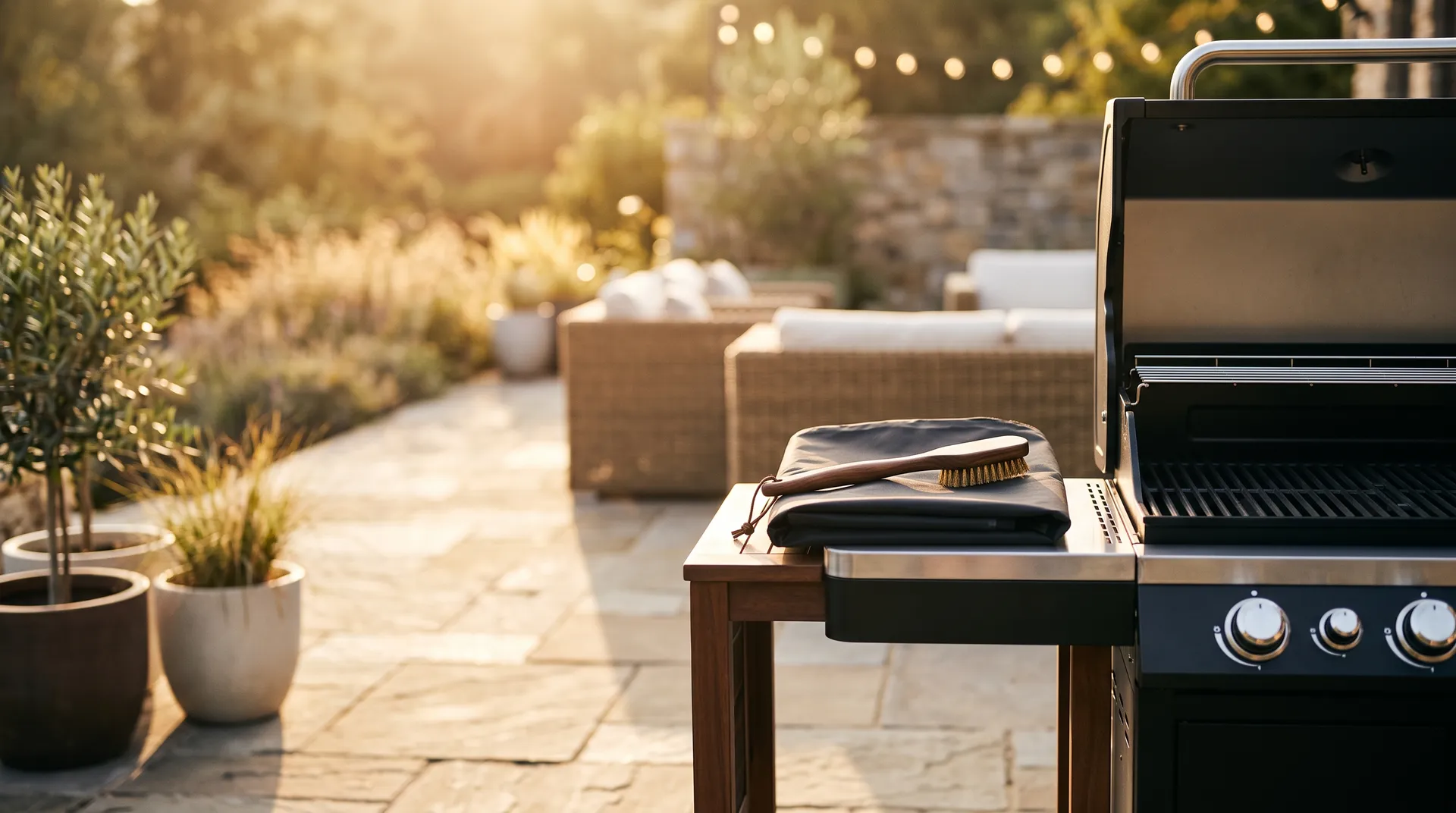

Heat the grill on high for 10–15 minutes after every cook and brush the grates while they're hot. Every 3–5 cooks, empty the ash pan or grease cup. Twice a season, deep clean: scrape the cookbox, clear the burners or firepot, wash the removable parts and leak-test the gas line.
Grease is what catches fire and carbon is what makes a grill run cool, so the after-cook habit does most of the work.
Which cleaning job do you need?
What you see tells you how deep to go.
Match what's in front of you to the job, then jump to it.
| What you see or want | What it needs | Go to |
|---|---|---|
| You just finished cooking | A burn-off and a brush | Step 1 |
| You're not sure what to clean when | The schedule | Schedule |
| Flakes on food, flare-ups or a grill that runs cool | A deep clean | Deep clean steps |
| A gas grill that needs a deep clean | Bars, burners, venturi tubes, tray | Gas grill steps |
| A pellet grill, kamado or griddle | Type-specific care | By grill type |
| The grill is going into storage | End-of-season care | Storage |
| Something's still wrong after cleaning | A diagnosis | Problems |
How often should you clean a grill?
Every cook, every few cooks and twice a season, by fuel type.
| How often | Gas | Charcoal | Pellet |
|---|---|---|---|
| Every cook | Burn off 10–15 min, brush grates | Brush grates, close vents to snuff coals | Brush grates, run the shutdown cycle |
| Every 3–5 cooks | Empty grease cup, scrape drip tray | Empty cold ash | Vacuum the firepot, change the drip-bucket liner |
| Monthly in season | Check the flame pattern | Check the vents move freely | Scrape the grease chute |
| Twice a season | Deep clean, leak test | Deep clean, check for rust | Deep clean, empty the hopper |
If you grill most days, deep clean monthly instead of twice a season. The twice-a-season job is the whole grill; the grates alone can get their own deep clean monthly, as our grate cleaning guide explains, and that's a sub-task, not a different schedule.
The schedule matters for safety, not just flavor. In the National Fire Protection Association's home grill fires report (2014–2018 annual averages), the grill had not been cleaned in 29% of home grill structure fires, and July was the peak month.
What do you need to clean a grill?
A brush, a scraper and soapy water cover almost everything.
- A grill brush or scraper suited to your grates (bristle-free if you prefer)
- A plastic putty knife or grill scraper for the cookbox
- Warm water, dish soap and a non-scratch scrub pad
- A shop vacuum for pellet and charcoal grills
- A thin wire or paper clip for burner ports
- Soapy water in a spray bottle for leak tests
- Food-safe oil and paper towels
- A breathable, fitted grill cover
Skip oven cleaner. It's harsh on coatings, paint and aluminum, and most makers say to keep it off cooking surfaces; warm soapy water and a scraper handle almost all grill grease.
Step-by-Step: How to Clean a Grill
Steps 1–2 are the after-cook habit; Steps 3–8 are the deep clean.
Step 1 of 8Burn off and brush the grates
Time: 10–15 minutes on high, then 1 minute of brushing
Turn the grill to high with the lid closed until the smoke stops. Brush the grates while they're hot, when carbon flakes off easily, then wipe them with a lightly oiled paper towel held in tongs.
The grate guide linked above covers which brush is safe for your grate material and the deep clean for cast iron, stainless and porcelain.
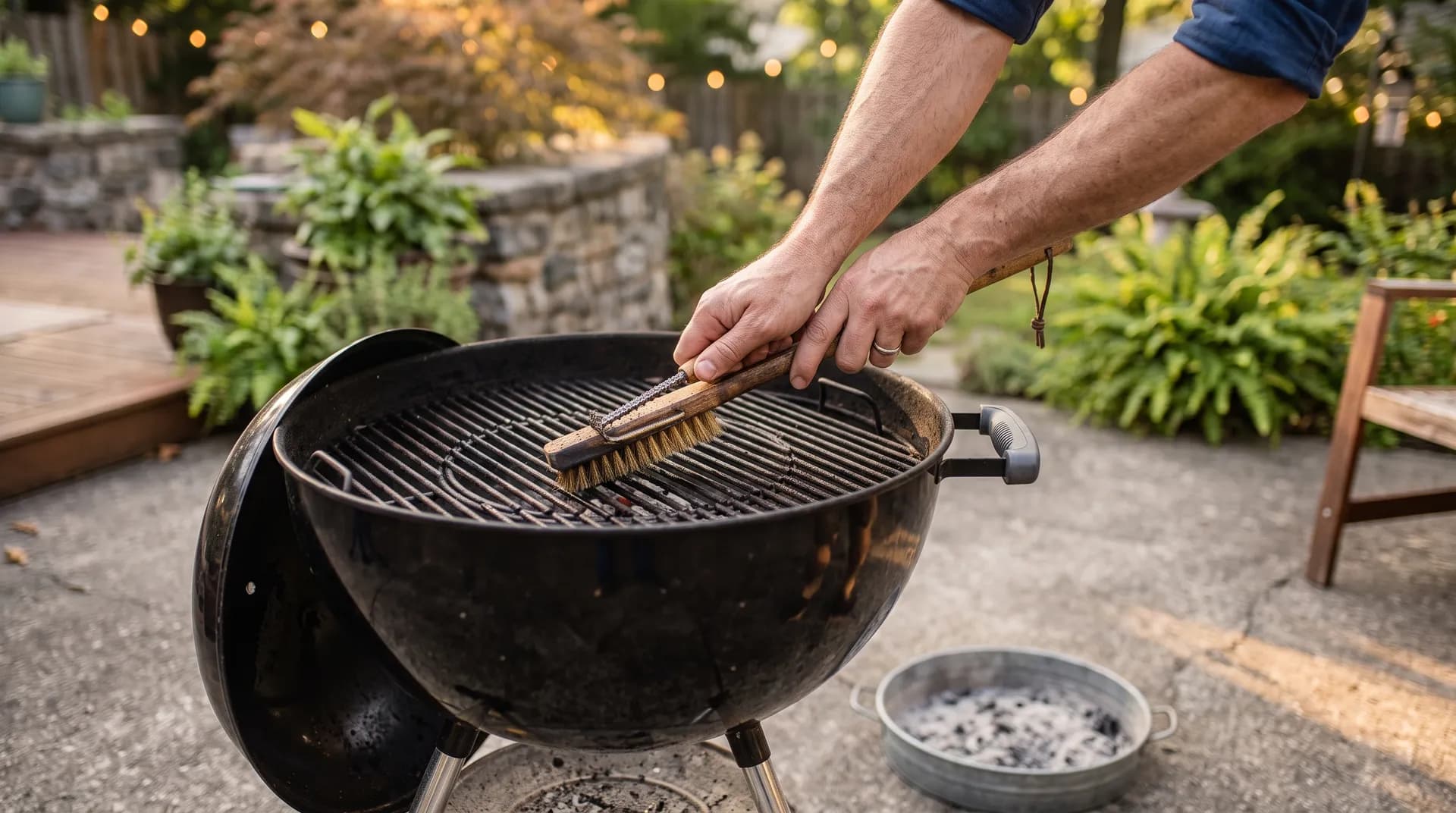 Keep a metal pan nearby so cold ash goes straight from the bowl into a fireproof container.
Step 2 of 8Empty the ash or grease
Target: an empty ash pan, or a grease cup less than half full
On charcoal, empty ash only once it's completely cold, and store it in a metal can. Ash left in the bowl soaks up moisture and rusts the bottom. On gas and pellet grills, swap the grease cup liner before it gets full.
Step 3 of 8Let it cool and take it apart
Done when: the grill is cold and the grates and flavorizer bars or heat plates are out
Disconnect the propane tank or unplug the pellet grill first. Lay the parts on a tarp or old towel so nothing scratches.
Step 4 of 8Scrape the cookbox
Target: no loose carbon flakes on the lid or walls
Scrape the inside of the lid and cookbox with a plastic scraper and push the debris down into the grease tray or ash pan. The flaky "peeling paint" on a lid is usually carbon, not paint, and it's what lands on your food.
Step 5 of 8Clean the burners or firepot
Done when: every port is clear, or the firepot is empty down to the metal
On gas, brush the burner tubes along their length, not across, and clear blocked ports with a paper clip. Wipe the igniter electrode tip too; if it's cracked or corroded, clean or replace the igniter electrode. On pellet, vacuum the firepot and the area under the heat baffle. On charcoal, brush the charcoal grate and clear the bottom vents.
Step 6 of 8Wash the removable parts
Time: about 20 minutes
Wash flavorizer bars, heat baffles and porcelain grates in warm soapy water, rinse and dry them fully. Don't soak or soap bare cast-iron grates; scrape them and oil them instead.
Step 7 of 8Check the gas line and seals
Done when: a soapy-water leak test shows no bubbles
Brush soapy water on the hose and connections, then open the tank valve with the burners off. Growing bubbles mean a leak: tighten the fitting or replace the hose before you light the grill.
On a pellet grill, check the lid gasket for gaps. On charcoal, make sure the vents open and close fully.
Step 8 of 8Reassemble, oil and burn off
Time: 15 minutes on high
Put everything back, wipe the grates with a thin coat of oil and run the grill on high to dry it out and set the oil.
You should see: steady blue flames with yellow tips on a gas grill. Lazy, mostly yellow flames mean ports are still blocked or the regulator needs attention.
How do you clean a gas grill?
Work from the grates down: bars, burners, venturi tubes, then the grease tray.
Do this as part of the twice-a-season deep clean, with the grill cold and the tank valve closed and disconnected.
- Lift out the grates and flavorizer bars. Scrape the bars (Weber's name for the metal tents over the burners; other brands call them heat plates or shields) and wash them in warm soapy water.
- Brush the burner tubes. Brush along each tube, not across, so debris isn't pushed into the ports, then clear any blocked ports with a paper clip.
- Clear the venturi tubes. These are the open ends of the burners that slide over the gas valves. Spiders and insects nest inside them, so run a venturi or pipe brush through each one and refit it squarely over its valve.
- Scrape the cookbox into the tray. Push carbon and grease down through the bottom opening with a plastic scraper.
- Empty the grease tray and cup. Scrape the tray, swap the cup liner and wash both if grease has caked on.
- Reassemble and test. Reconnect the tank, run the soapy-water leak test from Step 7, then light each burner and check the flame.
A blocked venturi can push flame back toward the control panel instead of out of the ports. If you see flame near the knobs, shut the gas off and clear the tubes before using the grill again.
 With the grates lifted out, you can brush each burner tube along its full length.
For the grates themselves, follow the grate guide, which covers the safe brush and deep clean for each material.
What extra care does your grill type need?
Each fuel has one extra job beyond the basic routine.
Gas. Check the flame pattern monthly, and clear the venturi tubes (see cleaning a gas grill) after the grill has sat for a few weeks. If the flames stay weak after a deep clean, work through why a grill is not heating up properly; if a burner won't light at all, see our gas grill ignition troubleshooting guide.
Charcoal. Keep the vents moving and the bowl dry. An ash-sweep system, like the One-Touch on the Weber Original Kettle 22, pushes ash into a catcher without lifting the grate, which makes the every-few-cooks job quicker.
Pellet. Store pellets dry and empty the hopper before long breaks, since damp pellets swell and jam the auger. Some designs make cleanup simpler: Traeger routes grease and ash on the Traeger Woodridge Pro into one pull-out keg.
Kamado. Run a high-heat burn now and then to clean the ceramic, never wash it with soap, and check the gasket for fraying. Oil any cast-iron vents and keep the grill covered; the cast-iron top vent on the London Sunshine 15-inch kamado and the bands and cart hardware on the VEVOR 18-inch kamado are typical spots where rust starts.
Flat-top griddle. A griddle needs the opposite of a grill brush: scrape it hot after every cook and keep it oiled rather than scrubbed bare. Our guide on how to season a griddle covers the full method.
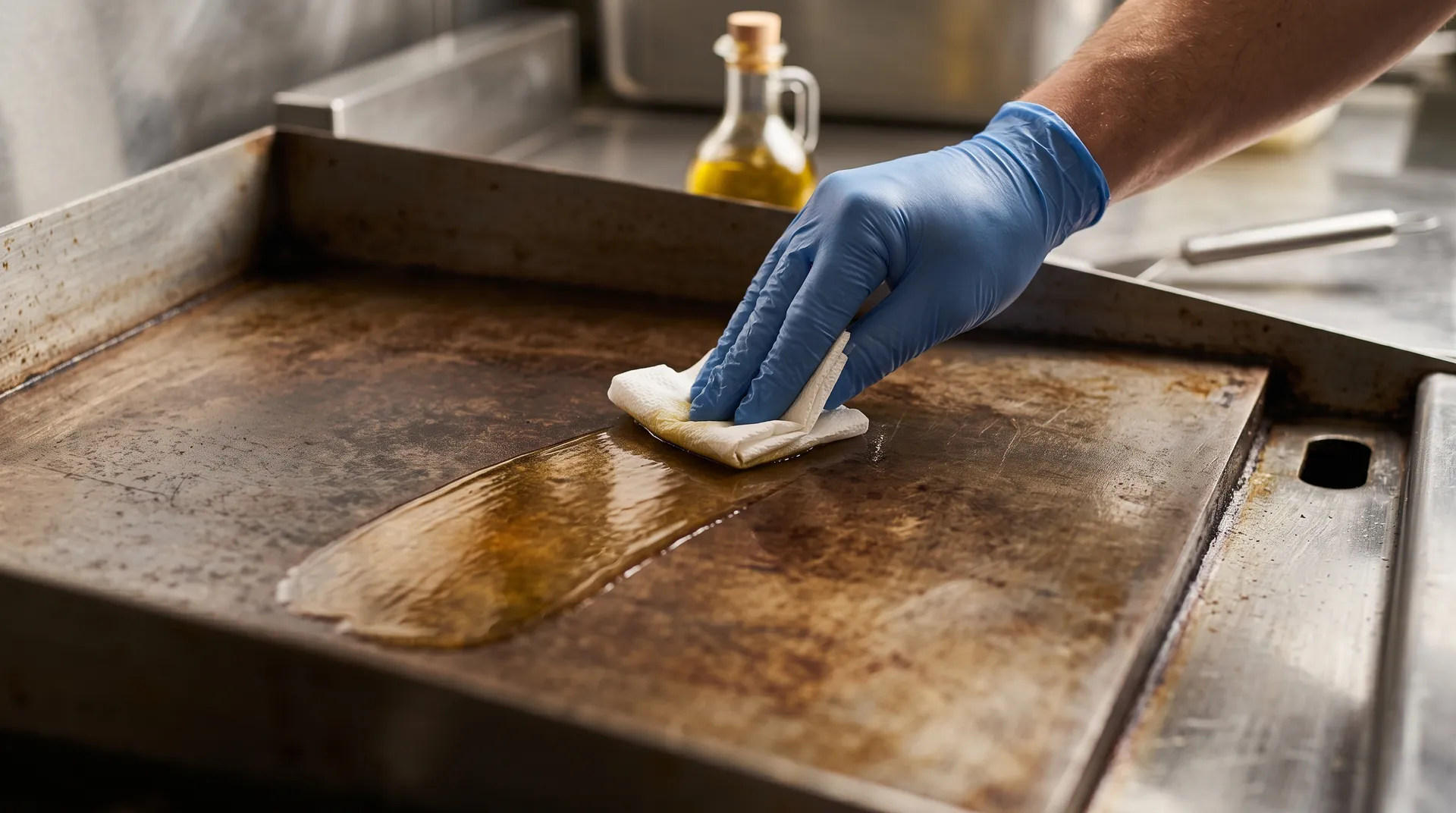 Spread the oil until the steel looks satin, not wet; puddles turn sticky.
On the Blackstone Original 36" Griddle, grease builds up in the rear channel, so scrape it down and empty the cup after every cook. The Traeger Flatrock routes it into a rear grease keg that lifts out to empty, which keeps grease off the patio.
How do you store a grill for the off-season?
Clean it, dry it fully and then cover it.
- Deep clean so grease doesn't sit and attract pests.
- Close the propane valve. If you store the grill indoors, leave the tank outside.
- Empty the pellet hopper and auger.
- Dry the grill fully before covering it. A wet grill under a cover rusts, and water in a burner tube or hopper freezes and expands.
Our checklist for how to winterize your grill covers cold-weather storage step by step.
In humid or coastal areas, salt air speeds rust, and even stainless can get surface spots from salt, moisture and grease. Keep the grill covered once dry. If you're buying a charcoal grill for a damp climate, stainless parts resist rust better than plated steel; the SnS MasterKettle has a 304 stainless hinged grate.
Why is your grill still flaring, sticking or rusting?
Most leftover problems trace back to one missed spot.
Sudden flare-ups
Sign
flames jump up through the grates whenever fat drips.
Fix
- Scrape the cookbox walls and the drip tray (Step 4).
- Empty the grease cup and replace its liner (Step 2).
Expect
short, small flare-ups that die back within seconds.
Grill runs cooler than it used to
Sign
it takes longer to preheat and won't reach its old top temperature.
Fix
- Clear clogged burner ports with a paper clip (Step 5).
- On pellet, vacuum the firepot; ash smothers the igniter and the fire.
Expect
preheat times and top heat back where they were.
Food sticks or picks up black flakes
Sign
food tears when you flip it, or dark flecks land on it.
Fix
- Burn off, brush and oil the grates (Step 1).
- Scrape the carbon peeling from the lid (Step 4).
Expect
clean release and no flakes. If food still sticks, our guide to why food sticks to the grill covers heat and timing causes.
Rust spots on the grates
Rust on the grates has its own fix by material; follow the rust section of our grate cleaning guide.
What to do if grease catches fire
Act fast and keep the lid closed.
- Gas: turn off the burners and the tank valve, then close the lid to starve the fire.
- Charcoal: close the lid and both vents.
- Pellet: close the lid and let the fan stop; don't open the hopper.
Never use water on a grease fire, because it can spread burning fat. Keep a multipurpose (ABC) fire extinguisher nearby, and if the fire spreads beyond the grill, get away and call 911.
Still not fixed?
A few problems need a repair guide, not more cleaning.
If the grill still runs cool after a deep clean, see why a grill won't heat up properly; if it won't light, try our gas grill ignition troubleshooting. Time for a new grill? If the burners or firebox have rusted through, our gas grill, charcoal grill and pellet grill reviews compare current models. When you shop, a one-motion ash sweep on charcoal, a single pull-out grease and ash container on pellet and a rear grease channel on a griddle all cut the routine to minutes.
Tools for this job: bristle-free grill brushes · grill degreaser · breathable grill covers. These are Amazon search links; we may earn a commission, which never changes our advice.
Frequently Asked Questions
01Should I clean my grill before or after cooking?
Both, briefly: brush after cooking while residue is soft, then let the next preheat burn off the rest. Residue that sits overnight hardens and gets sticky, and the 10–15 minute burn-off on high turns it to brittle carbon. Give the grates a quick brush once the preheat is done; our guide on how long to preheat a grill gives times by fuel.
02Do I need to clean a new grill before the first cook?
Yes, wash the grates and burn off the empty grill before food goes on. Factory oils and coatings smoke and taste off the first time they heat. Wash the grates in warm soapy water, dry them, then run the grill on high with the lid closed for the time the manual gives, often 15–20 minutes, and wipe the grates with a thin coat of oil.
03How often should you deep clean a grill?
Twice a season for most owners, or monthly if you grill most days. A deep clean means scraping the cookbox, clearing the burners or firepot, washing the removable parts and leak-testing the gas line. Between deep cleans, the every-cook burn-off and the every-3–5-cook grease or ash empty keep flare-ups and weak heat away. Put the next one on the calendar before the grill goes into storage.
04How do you clean a stainless steel grill?
Wipe it with warm soapy water or a stainless cleaner, following the grain, then dry it. Steel wool and chlorine cleaners scratch the finish and leave spots where rust starts. Stainless can still pick up surface spots from salt, moisture and grease, so dry the lid and cart after cleaning and keep the grill covered once it's dry. Do the outside when you do the twice-a-season deep clean.
05Can I pressure wash my grill?
Only the outside of the cart and lid, and gently. High pressure can strip paint and force water into burners, igniters and pellet-grill electronics, which then rust or short out. Clean the inside with a plastic scraper and soapy water instead, and run the grill on high for 15 minutes afterward to dry it out. Then wipe the grates with a thin coat of oil.
06Can you use oven cleaner on a grill?
No, skip it on most grills. Oven cleaner is harsh on coatings, paint and aluminum, and most makers say to keep it off cooking surfaces. Warm soapy water, a plastic scraper and a 10–15 minute burn-off handle almost all grill grease, and baked-on spots on the grates come off with the material-specific deep clean. Our grate guide covers that deep clean for each material.
07Should I line my grill with foil?
No, foil in the cookbox or grease tray causes more problems than it solves. It can block the airflow a fire or burner needs and trap grease where it pools and flares. Empty the grease cup or ash pan every 3–5 cooks instead, and swap the cup liner before it gets full. A clean tray does the job foil was meant to do, without blocking anything.
08Is it bad to never clean your grill?
Yes, a dirty grill is a fire risk and wears out sooner. Built-up grease catches fire, and NFPA's home grill fire data found the grill had not been cleaned in 29% of home grill structure fires. Carbon and rust also make food stick, smother burners and shorten the grill's life. Start with Step 1 after your next cook. A few minutes after each cook is all it takes.
The Takeaway
Burn off and brush after every cook, empty grease or ash every few cooks and deep clean twice a season. That routine takes a few minutes a week and keeps the heat even, the food from sticking and the grill working for years.
Written by
Tom Bricker
Consumer Research Analyst & Editor
Tom Bricker has 10+ years of grilling on every fuel type and a consumer-research background. He researches and writes SmokyHQ’s gas, portable, electric and flat-top coverage, so if you’re weighing price against how long a grill will last, his reviews compare specs, materials and warranties to show which ones look worth the money.
- Gas Grills
- Portable Grills
- Electric & Indoor Grills
- Griddles
- Value & Durability
Every grill is scored on the same research scorecard, from verified specs and documented owner feedback. How we research
Keep reading
More in Cleaning, seasoning & care

How to Winterize Your Grill
A one-hour checklist that keeps rust, pests and moisture out of your grill until spring, with notes by grill type, storage spots and a spring startup check.
Read the guide

How to Clean Grill Grates
The two-minute after-cook clean, the right deep clean for stainless, cast iron and porcelain grates, safe brush choices, rust fixes and when to replace them.
Read the guide
How to Season a Blackstone Griddle
Build a slick, rust-resistant seasoning on a Blackstone or any steel flat top in 3–5 thin coats, then fix sticky, flaking or rusty spots.
Read the guide